Ortigia about myths, legends and suggestions by Gian Luca Marino
6 places have to see

For Citymap Sicilia, Gian Luca Marino, journalist, writer, lover of stories, mysteries and old legends has written this guide on an evocative walk in the centre of Ortigia, Syracuse.
If you want to get to know him better, here is his Tik Tok and Facebook profile.
Ortigia, the beating and ancient heart of Syracuse, is an island with a thousand charms, cradle of myths and legends that can be experienced and retraced during a simple walk.
According to tradition, its name derives from the Greek ortyx (ὄρτυξ) meaning ‘quail’.
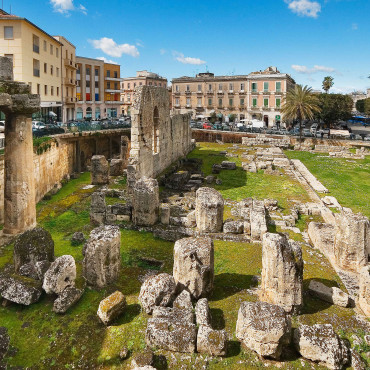
The itinerary starts at the Temple of Apollo where vestiges centuries old now coexist with the nearby stalls of what looks like a huge bazaar. The Temple, which was built in the 6th century BC, is the oldest Doric monument in Sicily. Over the centuries, the structure underwent several transformations: an early Christian church, an Arab mosque and a Norman basilica.
In 1537, Charles V ordered the individual stone blocks from the Temple to be used for the construction of the new walls of Ortigia. In 1778, Dominique Vivant Denon wrote in his Voyage en Sicile that, in order to be able to see part of the temple, he had to approach a private individual and gain access to the interior of his house. Only in the early 20th century was the area cleared of houses to make the remains of the temple visible.
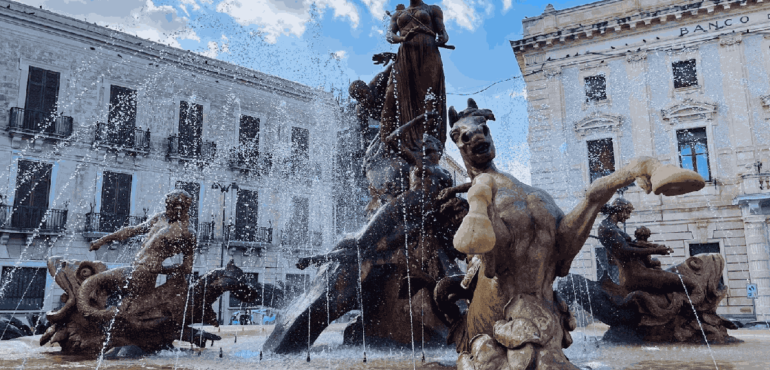
The walk continues to the Fountain of Diana in Piazza Archimede. A play of shapes, light and water. Built in 1906 by sculptor Giulio Moschetti, its works tell the legend of the nymph Arethusa that we will find again later. Admiring the fountain, one notices that Diana with her bow and dog is represented in the centre. At her feet is Arethusa lying at the moment when the goddess is about to transform her into a spring to save her from Alphaeus.
The latter appears at Diana’s right, surprised at the prodigy that is about to take place. Inside the pool, there are four sculptures representing a family of Tritons. The Triton and his companion with the baby in his arms each ride a pistrice, while the two teenage Tritons mount two sea horses. These mythological characters symbolise the sea, the element where the love story ends. In the lower part, the basin is surmounted on four sides by masks and coats of arms
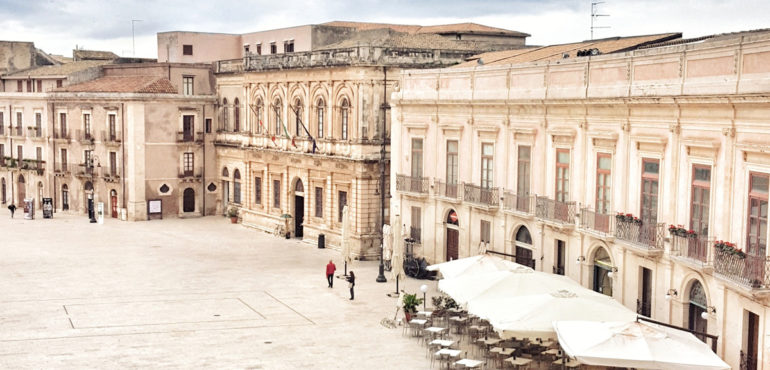
Passing through the elegant and characteristic central streets, one arrives at Piazza Duomo, a triumph of Baroque architecture, where the spirit and the senses are lost in space and architecture that suggest enchantment and wonder, sensations that can be summed up in the words spoken by a traveller: ‘Poignant music, the warm wind that envelops you, the darkness around you and the stars to light up the sky’.
The cathedral stands on the remains of an ancient temple where the cult of Athena was celebrated. In the 7th century, it was transformed into a Byzantine-style church dedicated to the Nativity of Mary. During the 1728 earthquake, it was largely destroyed and then rebuilt in Baroque style.
The chapels inside are important, such as that of the Baptistery, which contains a baptismal font made from a marble vase from the Hellenistic period, and that of the Crucifix, which contains a painting of St Zosimus by Antonello Da Messina.
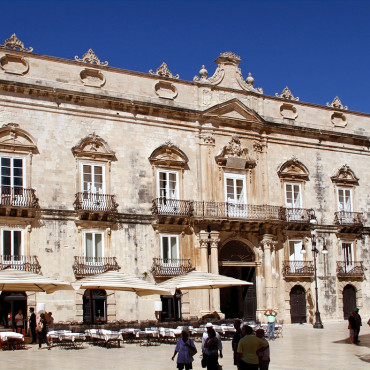
Surrounding the square are the baroque Beneventano dal Bosco Palace, known for having hosted Admiral Nelson, the Town Hall, the Borgia Impellizzeri Palace and the Church of Santa Lucia alla Badia, inside which you can admire a painting by Caravaggio.
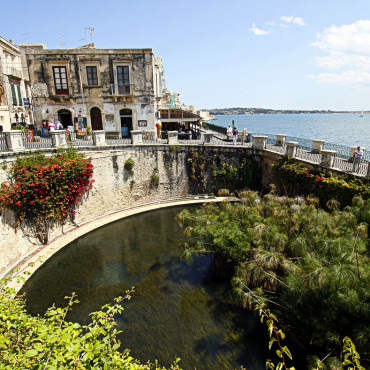
Following the route to the sea, one arrives at a place where reality and legend meet: the Arethusa Spring, a freshwater spring that gushes out at the seashore, forming a small lake inhabited by fish and plant species. According to the myth, Alphaeus, son of the god Ocean, felt an unrequited love for the nymph. Tired of the constant attentions, Arethusa asked Artemis for help, who enveloped her in a blanket of cloud and transformed her into a spring at the shore of Ortigia. Zeus, in order to help the inconsolable Alphaeus and to bring him closer to his beloved, transformed him into the river that flows in the harbour of Syracuse. Inside the spring of Fonte Aretusa is one of the only two wild papyreti existing in Europe, of millenary origin.
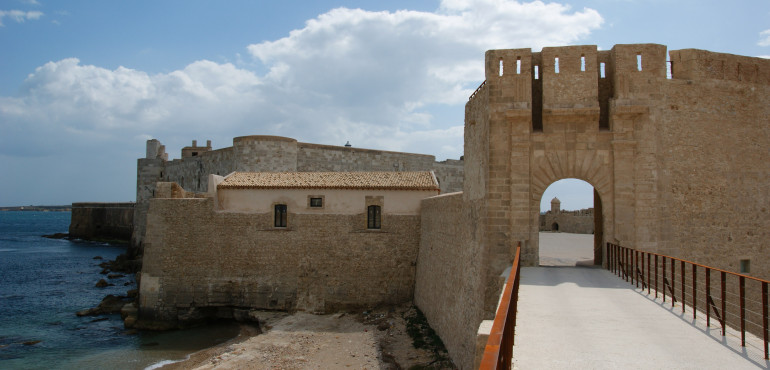
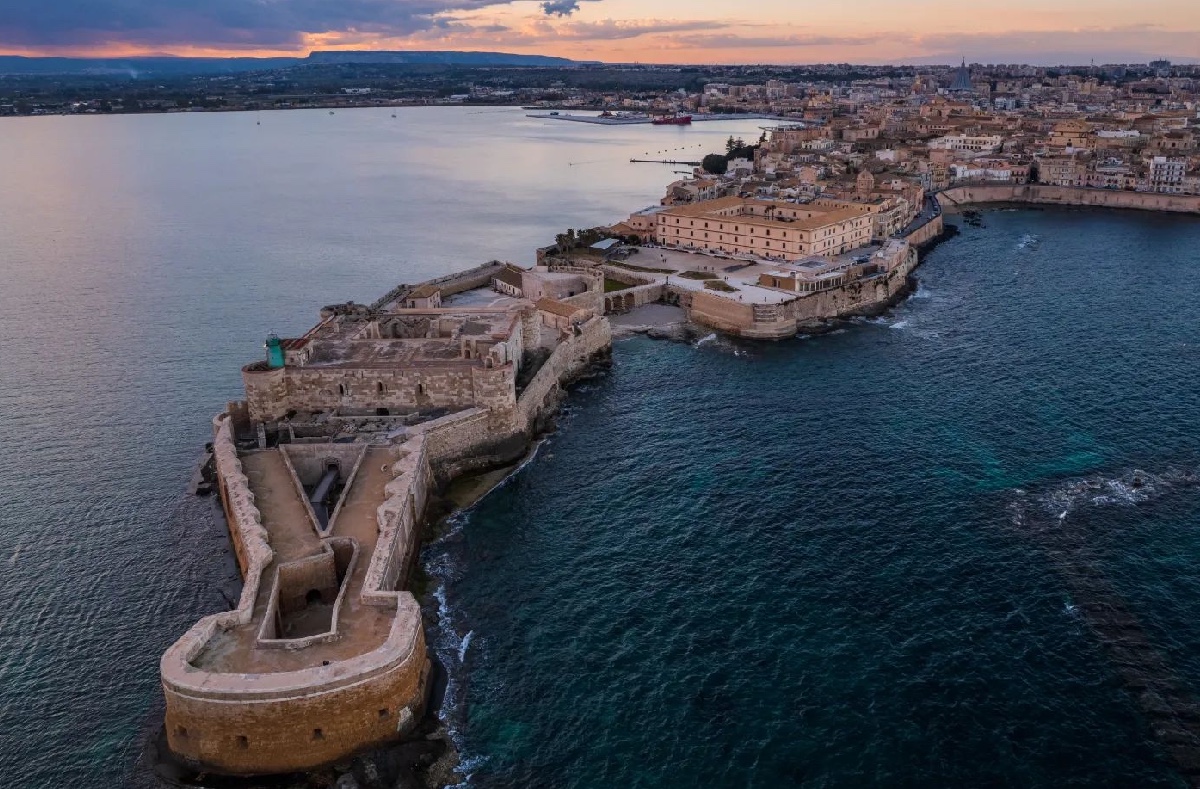
Along the sea is the road to Maniace Castle, which seems to emerge directly from the sea as if it were its own creature. Its origins are still disputed and the structure we see today is different from the original one. On the extreme tip of Ortigia there were earlier fortifications, perhaps even from the Byzantine era, as well as a temple dedicated to Juno. The central core was built by Frederick II of Swabia between 1232 and 1239 under the direction of Riccardo da Lentini, while the complex is named after the Byzantine general Giorgio Maniace, who defended the city against the Saracens.