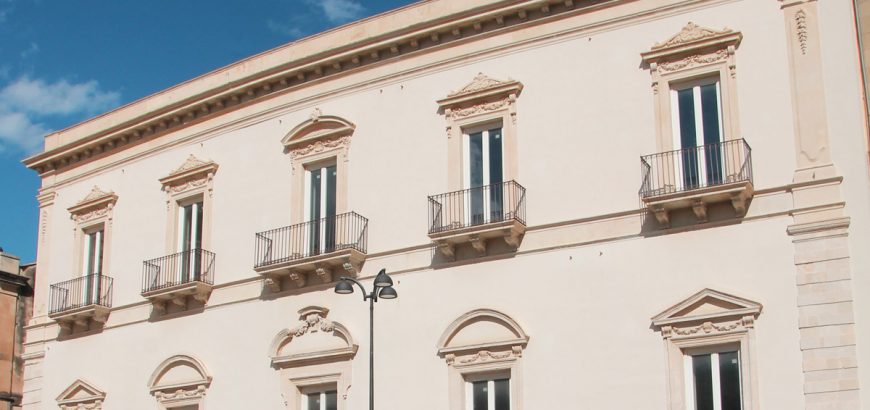
The main façade of the building
© @Fede Miceli
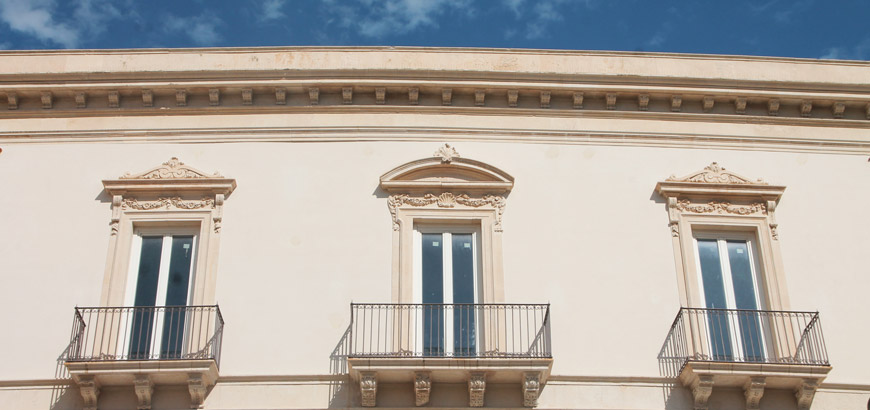
The convex elevation
© @Fede Miceli
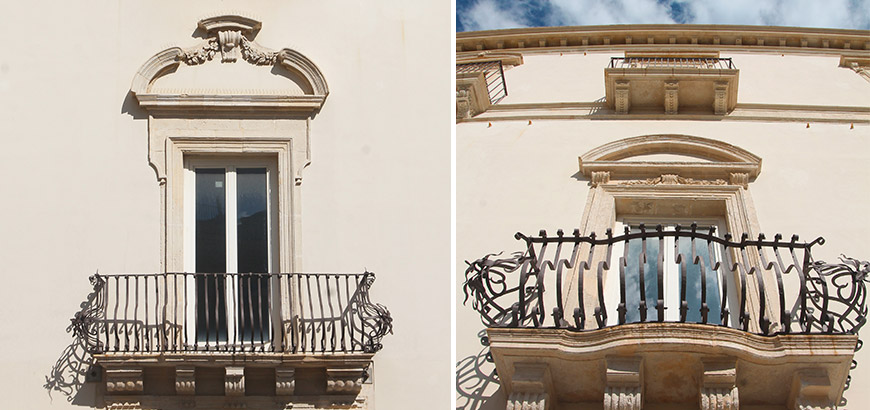
Balconies with late baroque decoration
© @Fede Miceli

The main façade of the building
© @Fede Miceli
The convex elevation
© @Fede Miceli
Balconies with late baroque decoration
© @Fede Miceli
Palazzo Pupillo is located east of Piazza Archimede and has a slightly convex elevation. Palazzo Pupillo has been declared a monumental asset by the Superintendence of the BB.CC.AA..
The eighteenth-century palace, built in the second half of the eighteenth century presents some late baroque forms. The particularity of the building lies in the decorations of the openings that feature festoons with leaves and flowers surmounted by plant motifs. The Palace, of considerable architectural merit and characterised by particular features, finds its definitive configuration in the early twentieth century.
The building is on three levels. The first includes the shops and is characterized by 4 lowered arch openings and by the entrance portal surmounted by the balcony. The main floor has, in addition to the central balcony, other 4 balconies surmounted by semi-circular or triangular tympanums. The third level has 4 balconies plus a central one surmounted by a curved pediment.
It has a first main entrance from Piazza Archimede, from which it is possible to access not only the main staircase for the elevated floors, but also a covered gallery that leads to various rooms on the ground floor and in the internal courtyards. Among the rooms on the ground floor, many have vaulted or cross vaults. Through the mentioned staircase, also with stone vaults, we arrive on the first floor, where there are very large rooms with vaulted ceilings and plaster, the largest of which with a nineteenth-century painting.
Also on the second floor on this front, the large rooms have all times in canes and plaster with paintings of the early twentieth century.
From the gallery on the ground floor you can go deep into the whole building, up to a large open courtyard, still owned by the Pupillo family, where there is the second main entrance, in common with Palazzo Montalto. Here, through another master staircase with stone vaults, you can access the other levels of the building and the entrance loggia on the main floor of Palazzo Montalto.